
Flight to SJO (San Jose) with the KLM dreamliner
✈️ Flight Overview
Another interesting flight and also a gift since I was called out of reserve for this which you may consider a best case scenario given the time of year ;)
🌪️ Weather & Routing
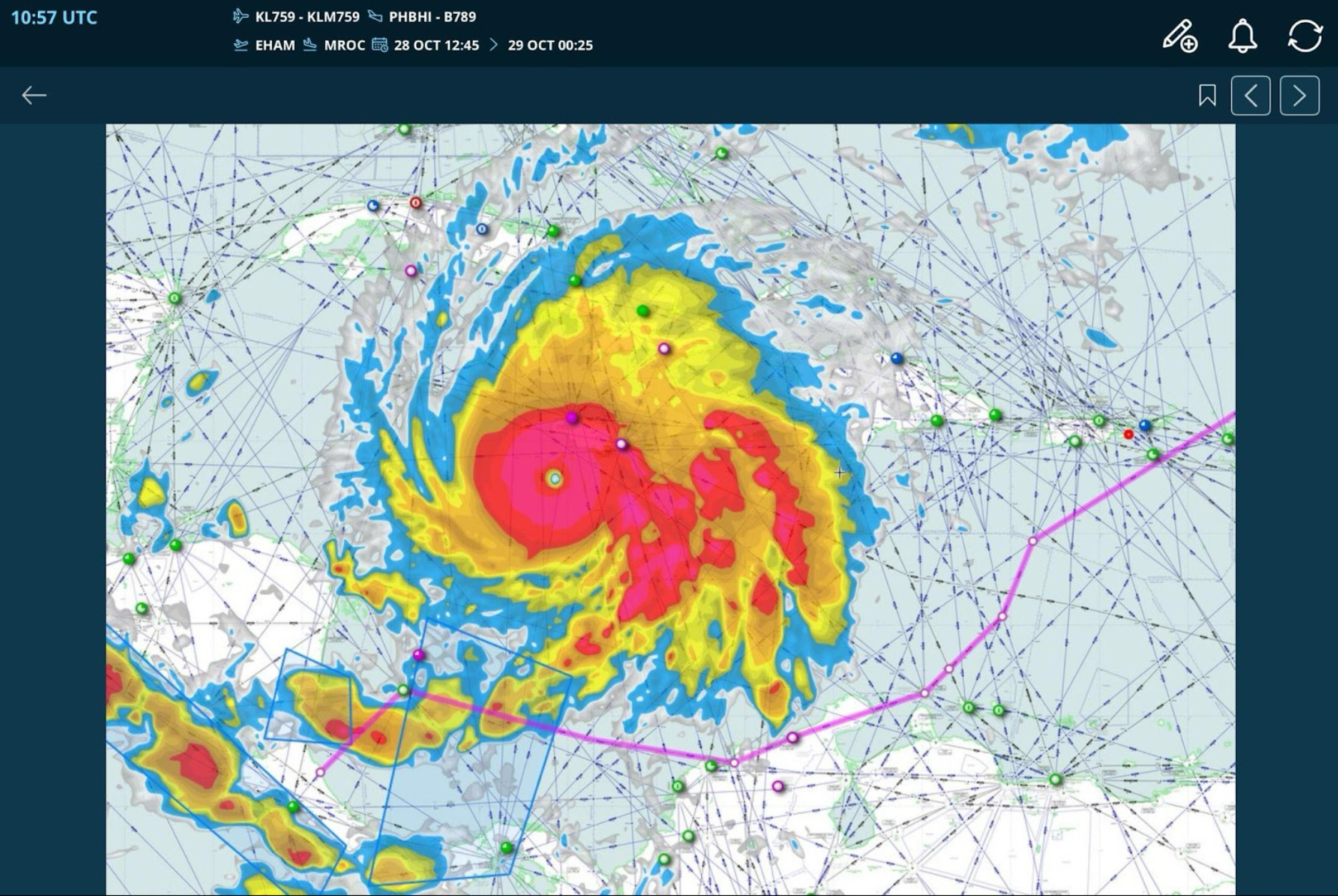
At the time Cat 5 hurricane Melissa was active in the Caribbean sea causing our route to be more to the south as usual to keep clear of weather. This is the weather for Montego Bay Jamaica where we saw a gusting 98 in the TAF (read: very hard wind in the forecast).
🔧 Technical Considerations
We had some inoperative systems requiring some non-normal flight planning and operations after consulting the DDL (dispatch deviations guide). This is where you have to be very sharp, for instance we had to increase flight planning fuel by 1.6%. Important details.
I tell myself read everything slowly and carefully, it is one of my weaknesses that I believe to quickly understand a situation.
🧭 In-flight Replanning
Quite some in-flight replanning eventually took place where we decided to cut off a large proportion of our route flying even more to the south in the final sector, more or less as drawn in the map with weather. We proposed the route to ATC as a relative long sequence of waypoints and airways.
When we were transferred to the next ATC unit they had not received our request and were able to go with a simpler option which had the same effect.
🗣️ Communication & CRM
Control questions such as “have you received our request” or requesting confirmation by spelling waypoints in the NATO alphabet and thinking way in advance contributed to a positive outcome here.
We were given a waypoint not in our route which sounded similar to a waypoint in our route. As a pilot when ATC gives you a waypoint you tend to look in the LEGS page of the CDU to see if you recognize it. It is an easy mistake to make.
🛬 Approach Planning (AR Approach)
In San Jose we prepared an AR (authorization required) approach. These are a special type of challenging RNAV (explained hereafter) approaches that may only be flown by the captain.
AR approaches are categorized by curved flight paths in the final approach segment (normally straight-in) and are often terrain critical. With such terrain a normal straight in approach on RWY 25 is not possible. With AR approaches special attention should be given to the terrain and what to do in case of a loss of RNP (required navigation performance) capability.
🛰️ RNAV Explained
RNAV approaches are a relatively new type of approaches that rely on the aircraft’s area navigation equipment instead of ground-based signals for the final approach path. For this reason they can be more easily implemented (no ground-based equipment required) and curved paths are possible (not possible for technical reasons with classical ILS approach).
🛬 Final Change
At more or less the last moment we were cleared for the ILS 07 (no mountains on this side so straight in approach possible). It is better to have this happening than the inverse, since an AR approach requires much more preparation.
I hope you enjoyed.
