
Interesting flight to Shanghai on a Boeing 777-200
✈️ Flight to Shanghai – Boeing 777-200
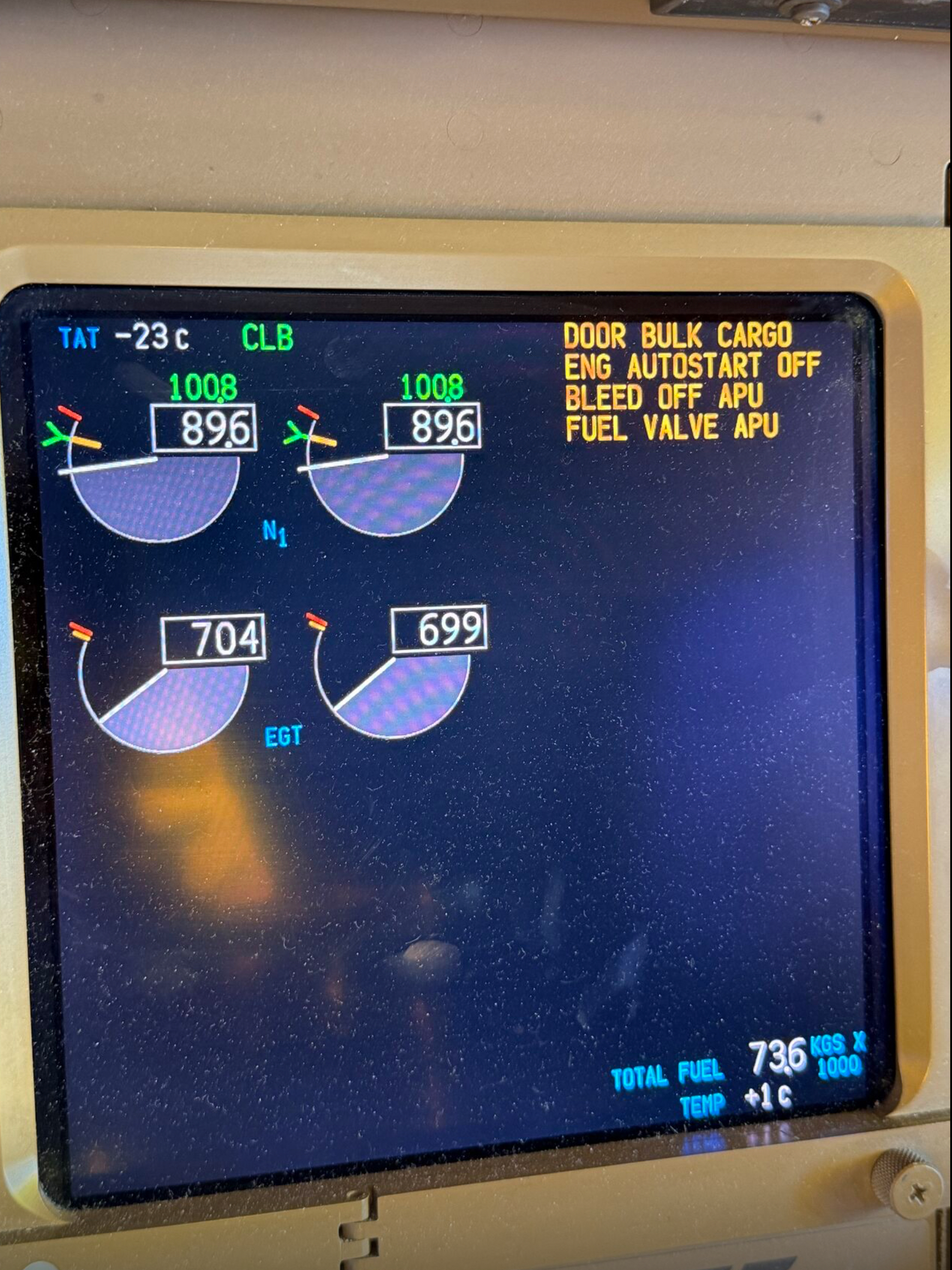
This yellow list of things on the EICAS (Engine Indicating and Crew Alerting System) represents things that are not working properly. You can still depart with many inoperative items as many are not required for safe flight, I once explained this in a post.
🔧 Engine Start Challenges
It was quite an interesting beginning of the day as some systems that normally help with engine start were inoperative. Firstly the APU (auxiliary power unit, a turbine engine in the tail of the aircraft), that you normally use to blow air into the engine to start its rotation required for engine start. In this instance we did that with a ground starter. Also the autostart was inoperative, so we had to do a manual start as well. Those are all supplementary procedures, not part of the normal operation of the aircraft.
⚠️ In-flight Warning
Then to our surprise, during cruise, we got a door bulk cargo warning. This is something you don’t like to see because if there truly is a problem with the bulk cargo door, you might expect a rapid decompression and subsequent emergency descent.
This however, is extremely unlikely, due to the design of the bulk cargo door (it opens to the inside so is pressed by the cabin pressure against the hull of the aircraft). We immediately checked the cabin altitude and noticed it was constant (as it should be). We called with maintenance and it was then believed to be a faulty sensor and we continued the flight normally. In these instances it is good to have highly trained pilots to make such calls.
🧠 Decision Making & Technical Insight
Information gathering and technical insight (of the aircraft door mechanism and the consequences of which) contributed to decision making here, which is very interesting. They are both competencies that will be tested in your airline selection and will therefore be trained at Aviation Talent Training.
⚖️ Risk Management in Aviation
In this instance with the flight path under control and plenty of time for thinking we become risk managers within a commercial environment. It always comes back to the same tradeoff, within the so called “socio-technical field”, between commercial, workload and safety considerations.
Whenever decision makers interact, game theory explains their optimal and therefore expected behaviour, providing a tool distance yourself from the situation and deal with it more elegantly.
♟️ Game Theory & Airline Selection
The same line of reasoning explains why students in a competitive environment (airline selection) maximise their capabilities through training: it is a so called “Nash Equilibrium”: a scenario where every player in the scenario chooses their best strategy, and has no incentive to deviate, since it will lead to a worse outcome. This holds true for every competitive environment in the world. You could call it: behavioural law. Interesting right?
🚀 Interested?
Wil jij ook nadenken over complexe problemen maar begeef je je liever in een dynamische en technische omgeving? Dan kan vliegen wat voor jou zijn!
Klik op onze contact pagina en meld je aan voor een gratis intakegesprek!
